The Catholic Pilgrim's Guide to Guadangolo (Mentorella), Italy
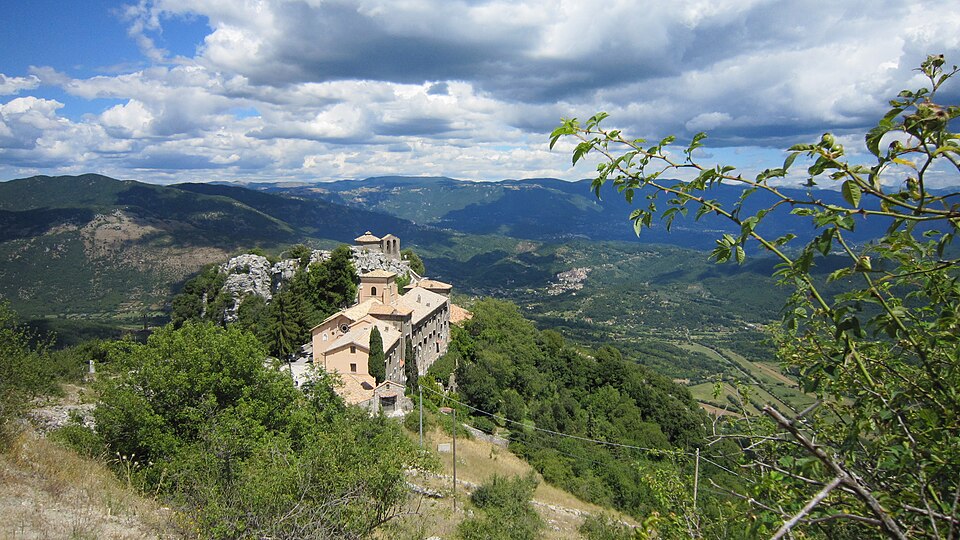

Perched on a dramatic limestone cliff at 1,018 meters in the Prenestini Mountains, the Sanctuary of the Mentorella stands as one of Europe's oldest Marian shrines—a sacred place that has drawn pilgrims for seventeen centuries, from Emperor Constantine to Pope St. John Paul II
Whether you're a devout Catholic seeking the mountain refuge that captivated a Polish pope or simply a curious traveler drawn to ancient sacred sites, Mentorella offers something increasingly rare: a place that demands effort to reach yet rewards with an encounter unchanged across the centuries.
---
The Legend of St. Eustace: Where It All Began
The story begins in the 1st or 2nd century AD, when a Roman general named Placidus was hunting near Tivoli. Renowned for both military prowess and natural charity toward the poor, Placidus pursued a magnificent white stag that fled to a high rocky outcrop—the very cliff where Mentorella now stands. Looking up, the general beheld an extraordinary vision: Christ crucified appearing between the stag's antlers, surrounded by radiant light. A divine voice spoke: "Placidus, why are you pursuing me?" The stunned general converted immediately, received baptism along with his wife Theopista and sons Agapius and Theopistus, and took the Christian name Eustace. Today, the Polish Resurrectionist Fathers welcome pilgrims to this remote sanctuary, continuing a 165-year vigil of prayer and hospitality. The tiny hamlet of Guadagnolo—Italy's highest inhabited village in Lazio at 1,218 meters—serves as the gateway, home to just 55 residents yet offering panoramic views extending up to 125 kilometers on clear days. From the village piazza, pilgrims can see the Gran Sasso d'Italia, Monte Terminillo, the Tyrrhenian Sea, and on exceptionally clear days, even the distant silhouette of Corsica.
---
History and Spiritual Significance
The Martyrdom of St. Eustace
Eustace's life after his conversion reads like Job's trials multiplied. His wealth was stolen, servants died of plague, a ship captain kidnapped his wife, and wild animals—a wolf and lion—carried off his two sons while crossing a river. He lived in exile in Egypt before Emperor Trajan recalled him to lead military campaigns. Miraculously reunited with his family after years of separation, Eustace refused Emperor Hadrian's demand to sacrifice to pagan gods. The entire family was martyred in approximately 118 AD, first thrown to lions who refused to harm them, then placed in a brazen bull. Their bodies emerged miraculously preserved. St. Eustace is venerated today as one of the Fourteen Holy Helpers, with his feast day celebrated on September 20.
The Constantinian Foundation
Following Emperor Constantine's conversion and the Edict of Milan in 313 AD, the Emperor learned of the sacred site where Eustace had encountered Christ. Wishing to honor the early martyr publicly, Constantine commissioned a church on the rocky cliff. Pope St. Sylvester I consecrated the sanctuary during his pontificate (314–335 AD). According to legend, Sylvester received an apparition of the Blessed Virgin Mary who admonished him to fulfill the Emperor's wishes and dedicate the church in her honor as well as that of St. Eustace. When architects objected to the impossible building site, the pope replied simply: "Vult illa"—"She wills it." This phrase is claimed as the etymology of the sanctuary's name: Vult-illa → Vultuilla → Vulturella → Montorella → Mentorella.
St. Benedict's Hermitage
The sanctuary gained additional sacred significance when St. Benedict of Nursia (480–547), father of Western monasticism, lived as a hermit in the natural cave beneath the church for approximately two years before moving to Subiaco. This occurred during Benedict's withdrawal from the world as a young patrician, creating an enduring spiritual link between Mentorella and the great Benedictine foundations nearby. Around 594 AD, Pope Gregory the Great donated the sanctuary to the Benedictine monks of Subiaco. For centuries thereafter, Mentorella functioned as one of the twelve monasteries associated with St. Benedict's foundations. The precious wooden statue of the Madonna—carved in oak, depicting Mary seated with the Infant Jesus—was created by an unknown artist, possibly a Benedictine monk, during the 11th–12th century. This remains one of the most important examples of medieval wooden sculpture in Lazio.
Father Athanasius Kircher's Miraculous Restoration
The late medieval period brought decline. When the Holy House was translated to Loreto in the late 13th century, pilgrims were drawn to that more accessible destination, and support for remote Mentorella collapsed. By the end of the 14th century, Benedictine monks abandoned the sanctuary, and the church fell into ruin. The sanctuary's rebirth came through an extraordinary figure: Father Athanasius Kircher, S.J. (1602–1680), a German Jesuit polymath based at the Roman College. In 1661, while exploring the Prenestini Mountains for his studies on Latium, Kircher discovered the ruined sanctuary—its church "almost collapsing with age and open to the air," with a wooden Madonna statue "eroded by age, covered with dust and cobwebs." Kircher reported that the Virgin Mary spoke to him directly: "See how I am neglected here in this wilderness? Nobody cares about Me, nobody cares about My church and this sacred place, where I was venerated so much by people in earlier times." He vowed to restore the sanctuary and spent four years researching its history. His 1665 book Historia Eustachio-Mariana raised funds from Catholic rulers across Europe, including Emperor Leopold I (1,000 imperials) and the Elector of Bavaria (400 scudi). Restoration occurred between 1665–1680. Among Kircher's innovations: a system of speaking trumpets (megaphones) pointed toward surrounding villages, allowing calls to Mass to broadcast several miles. Kircher spent his final years at Mentorella. Upon his death on November 27, 1680, his body was buried at Il Gesù in Rome, but his heart was transported to Mentorella and buried beneath the main altar, per his express wish.
The Resurrectionist Fathers
In 1857, Pope Pius IX entrusted the sanctuary to the Congregation of the Resurrection of Our Lord Jesus Christ—a Polish religious congregation founded in Paris in 1836 by émigré laymen following the failed November Uprising against Russian rule. In 1864, Pius IX ceded the sanctuary to the Resurrectionists "in perpetuum." Following Italian unification, the sanctuary was confiscated by the Italian state in 1870, then put to auction in 1880. The Resurrectionist Fathers repurchased their own sanctuary in 1883 for 8,500 lire. They have served continuously since, now marking over 165 years of Polish custodianship—a connection that would later prove providential when a Polish pope discovered this mountain refuge.
---
About the Sanctuary
Local Name (Italian): Santuario della Mentorella Dedication: Our Lady of Mentorella, Mother of Graces (Madonna della Mentorella, Madre delle Grazie) Website: santuariodellamentorella.jimdofree.com
Architecture and Highlights
The church maintains the Romanesque style of 12th-century Roman basilicas, featuring three naves divided into four bays, with a wooden roof of exposed beams. The structure incorporates portions of the original Constantinian-era church, making this one of the oldest continuously venerated Christian sites in Europe. The sanctuary's most precious treasure sits encased in glass atop the marble ciborium above the main altar: the 11th–12th century wooden Madonna and Child carved in oak. The statue depicts Mary seated, holding the Infant Jesus, both wearing royal crowns. The Vatican Chapter solemnly crowned this statue on September 29, 1901. In 1972, the statue was stolen; the Carabinieri recovered it approximately one year later. A silver rose blessed by Pope Benedict XVI on August 22, 2007 now rests alongside it, commemorating 150 years of Resurrectionist presence.
Three Levels of the Sanctuary
The sanctuary operates on three levels: Chapel of St. Eustace stands at the summit, built on the rock where tradition places Christ's apparition to Placidus. Frescoes depict the saint's conversion and martyrdom. The bell tower's three rope-pulled bells bear the inscription: "Do not act as a bell-ringer if your heart does not beat as a Christian." The Church houses the main altar with the precious Madonna statue and significant relics. Lo Speco (The Cave) below the church is a natural cave dedicated to St. Benedict, containing an altar and image of the saint who lived here for two years. Pilgrims descend via stairs to pray in this narrow rock cleft, lighting candles as generations have done before them. The Scala Santa (Holy Staircase), built by Kircher in the 17th century and renovated in 1947, connects the church to the Chapel of St. Eustace above.
Sacred Relics
The sanctuary preserves several significant relics:
- The heart of Athanasius Kircher beneath the main altar (since 1680)
- The heart of Pope Innocent XIII (Michelangelo dei Conti, 1655–1724), housed in a marble urn on the right pillar
- The remains of Cardinal Bernardo Maria Conti, relative of Innocent XIII
Plenary Indulgence
Pilgrims may obtain a plenary indulgence (under the usual conditions) on the last Sunday of August or on any day of the year when making a devout visit to the sanctuary.
---
Pope John Paul II's Deep Bond with Mentorella
The widely repeated claim that Pope John Paul II visited Mentorella "over 100 times" cannot be verified through primary sources. The sanctuary's photo gallery documents eight papal visits between 1978–2000. However, John Paul II himself confirmed numerous earlier visits: "From the opening of the Second Vatican Council, I have had the opportunity of staying in Rome several times... On the occasion of these stays in Rome, I have often visited the sanctuary of Our Lady of Mentorella."
Documented Papal Visits
His first papal visit came on October 29, 1978—just thirteen days after his election, making Mentorella his first destination outside Rome as pope. He returned on:
- March 31, 1979
- December 28, 1987
- April 17, 1990
- December 27, 1991
- December 30, 1996
- October 28, 1997
- February 3, 2000 (his last documented visit, shortly before his health declined)
The Pope also visited "a few days before the last Conclave" in October 1978—a private retreat before his election.
A Personal Sanctuary
As an avid mountaineer, John Paul II loved hiking the trails around the sanctuary. According to the Resurrectionist Fathers, he would request to be "literally locked inside the church" for hours of uninterrupted contemplation. The fathers prepared a room in the convent for his rest—occasionally shown to visitors today. His bond with the Polish Resurrectionist Fathers extended beyond Mentorella: some attended lectures alongside him at Jagiellonian University, others were his students in the 1950s, and several received ordination through his ministry as Metropolitan of Kraków.
Memorials
Two bronze statues of John Paul II welcome pilgrims at the sanctuary entrance, donated by twelve surrounding municipalities. A photo gallery adjacent to the sanctuary documents all his visits. The Sentiero Karol Wojtyła (Wojtyła Trail), inaugurated in 2004, marks the hiking path from Pisoniano that the Pope himself walked—approximately 6 kilometers over 2–2.5 hours. Pope Benedict XVI honored his predecessor by visiting Mentorella on October 29, 2005—exactly 27 years to the day of John Paul II's first papal pilgrimage.
---
Annual Feast Days and Celebrations
Last Sunday of August – Feast of Maria Santissima Madre delle Grazie The principal feast draws pilgrims from throughout the region for solemn Mass at 11:30 AM (often presided by the Bishop of Tivoli), Eucharistic Adoration at 3:30 PM, and afternoon Mass at 5:00 PM. A plenary indulgence is available under the usual conditions. August 15 – Assumption of the Blessed Virgin Mary Special liturgies honor Our Lady's bodily assumption into heaven, with pilgrims gathering in the cool mountain air while Rome swelters below.
---
Where to Stay
Sanctuary Guesthouse (Resurrectionist Fathers)
Address: Via della Mentorella 1, 00030 Guadagnolo, Capranica Prenestina (RM) The monastery complex includes guest accommodations: 25 beds for organized groups (scouts, religious communities) and 8 double rooms in the religious house. Contact the sanctuary to inquire about availability and spiritual retreat programs.
Ristorante Da Peppe (Dining)
Address: Piazza Dante Alighieri 10, 00030 Guadagnolo (RM), Italy Traditional Lazio cuisine—homemade pasta with wild boar or porcini, grilled meats, local cheeses. Open Tuesday–Sunday, approximately €25–30 per person. Reservations strongly recommended, especially Sundays.
Hotel Ristorante Stella ⭐⭐⭐
Address: Palestrina (RM), 22 km from Mentorella Small hotel offering comfortable rooms in the historic town of Palestrina, convenient for pilgrims visiting multiple sites.
B&B La Dea Fortuna
Address: Via Prenestina Nuova, 313, 00036, Palestrina (RM) Website: ladeafortuna.it/en/ Charming bed and breakfast in the ancient Latin city of Praeneste, within easy driving distance of Mentorella.
---
How to Get There
By Car (Recommended)
Take the A24 motorway (Rome–L'Aquila direction), exit at Tivoli, then follow provincial roads through Palestrina and Capranica Prenestina to Guadagnolo. The mountain road features many hairpin bends—drive carefully. Distance from Rome: approximately 52–53 km Driving time: 1–1.5 hours Alternative route: Via A1 motorway, exit at San Cesareo or Valmontone, then through Palestrina. Large parking area near the sanctuary (also serves as a helipad). Additional parking in Guadagnolo's Piazza Dante Alighieri.
By Public Transport
COTRAL buses from Rome's Anagnina Metro Station (Line A) serve Palestrina and surrounding villages, but connections to Guadagnolo are limited (twice daily, Monday–Saturday). A car is strongly recommended for this pilgrimage.
On Foot: Pilgrimage Trails
Six marked trails approach the sanctuary, allowing pilgrims to make the physical ascent part of their spiritual journey: Sentiero Karol Wojtyła (Trail #502): From Pisoniano, 2.5 hours, with rosary stations marking the Joyful, Luminous, Sorrowful, and Glorious Mysteries—the path John Paul II himself walked Sentiero dei Pellegrini: From Ciciliano, 3.5 hours Sentiero delle Creste: From Capranica Prenestina via Monte Calo, 4 hours—spectacular ridge walking with panoramic views Sentiero Papa Gregorio Magno: From San Gregorio da Sassola, 4.5 hours Sentiero Attrezzato A. Kircher: 30 minutes, experts only (via ferrata requiring equipment) Guadagnolo to Mentorella: 1.5–2 km, 20–30 minutes, easy descent
---
Nearby Pilgrimage Destinations
Subiaco and the Sacro Speco (25–30 km)
The Sacro Speco (Sacred Cave) monastery is built around the cave where St. Benedict lived as a hermit for three years before founding Western monasticism. The Upper and Lower Churches contain extraordinary 13th–14th century frescoes, including the oldest surviving portrait of St. Francis of Assisi (painted during his lifetime, c. 1223). The Sacred Cave holds a marble statue of St. Benedict by Antonio Raggi, disciple of Bernini (1657). Six monks currently reside here. Nearby stands the Abbey of Santa Scholastica, the oldest Benedictine monastery still in existence. Both sites share a direct spiritual connection with Mentorella, where Benedict himself lived before founding his Subiaco communities.
Palestrina (22 km)
The ancient Latin city of Praeneste offers the Cathedral of Sant'Agapito Martire (Suburbicarian Diocese of Palestrina), containing relics of Saints Agapito, Abbondio, and Giordano. The city is the birthplace of Giovanni Pierluigi da Palestrina, the Renaissance master of sacred polyphony. The archaeological Sanctuary of Fortuna Primigenia and the famous Nile Mosaic attract cultural visitors.
Genazzano – Sanctuary of Our Lady of Good Counsel (47 km from Rome)
This Minor Basilica houses the miraculous 15th-century fresco of Our Lady of Good Counsel, which tradition holds arrived miraculously from Albania in 1467. Pope Leo XIII added "Mother of Good Counsel" to the Litany of Loreto. Multiple popes have visited, including John Paul II (1993) and Benedict XVI.
---
Suggested Multi-Day Pilgrimage Itinerary
Day 1: Rome to Palestrina—Cathedral of Sant'Agapito, archaeological sites Day 2: Palestrina to Mentorella—hike or drive; evening prayer at sanctuary; overnight at Guadagnolo or sanctuary Day 3: Mentorella to Subiaco—morning Mass, then hike or drive to Sacro Speco and Santa Scholastica Day 4: Subiaco to Genazzano—visit Sanctuary of Our Lady of Good Counsel; return to Rome
---
Practical Information
Address: Via della Mentorella 1, 00030 Guadagnolo, Capranica Prenestina (RM), Italy GPS Coordinates: 41.9212919, 12.9364636 What3Words: reshoot.depending.normality
---
Inspiration
"This place, hidden among the mountains, has particularly fascinated me. From it, one's eyes can range over and admire the magnificent view of the Italian landscape. This is a place in which man opens to God in a special way. A place where, far from everything, but also at the same time close to nature, one can speak confidentially to God himself. One feels within one what is man's personal call. During my stays in Rome, this place helped me a great deal to pray. I wanted to come here, among these mountains, to sing the 'Magnificat' in Mary's footsteps."
— Pope St. John Paul II, Address at the Sanctuary of the Mentorella, October 29, 1978